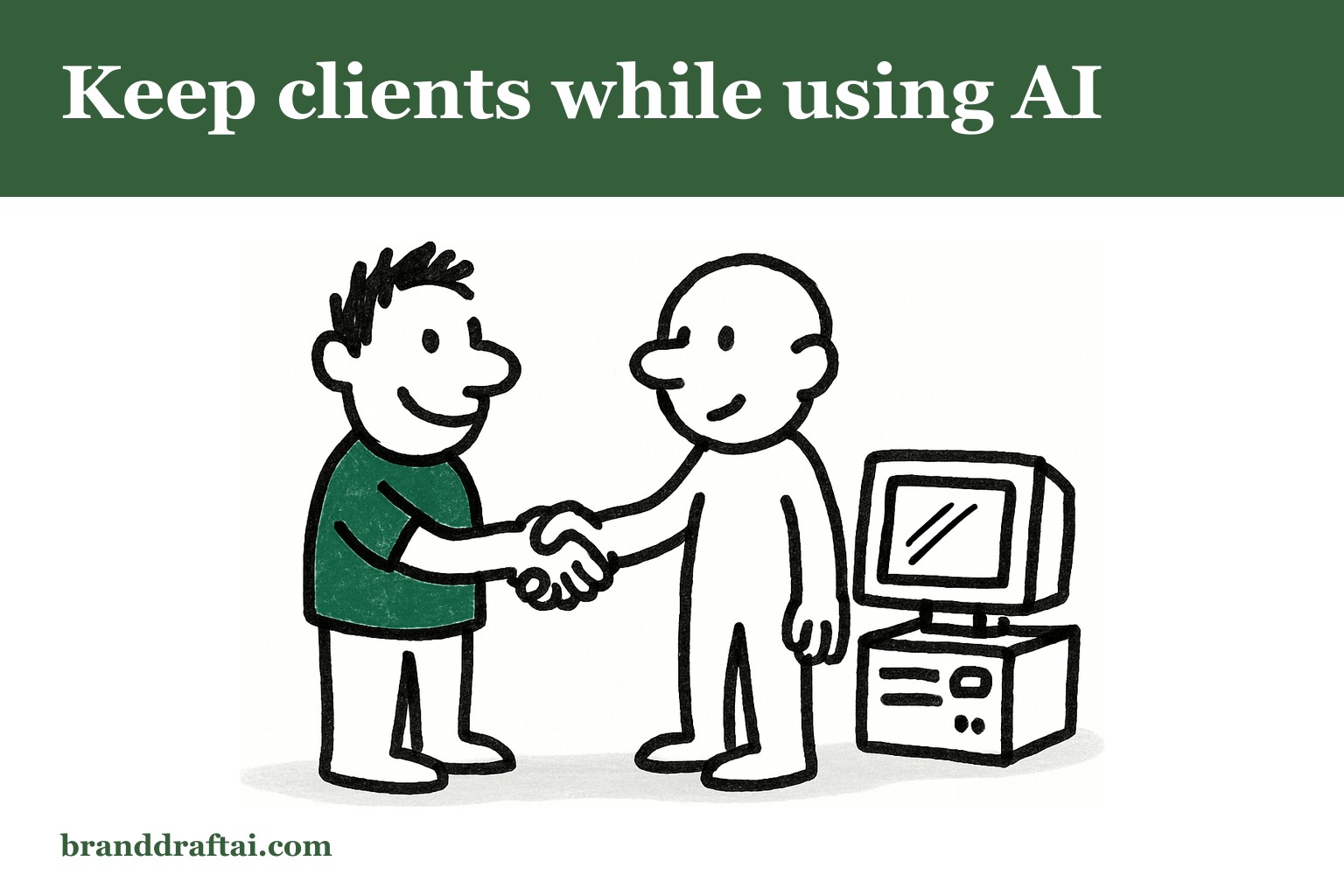

How content marketing agencies are using AI without losing client trust
The client called Tuesday morning. "This doesn't sound like us at all." The content was grammatically perfect, hit every keyword target, and read like it came from a template factory. Three months of work, and now they're questioning whether the agency understands their business at all.
This conversation happens daily across content marketing agencies trying to integrate AI tools. The ones losing clients treat AI like a faster typewriter. The ones keeping clients treat it like a research assistant that needs direction.
The transparency conversation nobody's having right
Most agencies handle AI disclosure like a legal requirement. "We use AI tools to assist with content creation" buried in project documentation. Clients discover the truth when the output sounds like every other company in their industry.
The agencies that keep trust flip this completely. They lead with what AI can't do. "AI doesn't know your customer calls your product by its nickname, not the official name. It doesn't know you avoid certain terminology because of that lawsuit three years ago. That's why we start with a conversation about what makes your voice different."
Sarah Chen, who runs content strategy for a 40-person agency in Denver, puts it directly: "When we tell clients we use AI, we immediately follow with what we do that AI doesn't. It's not about hiding the tool , it's about highlighting the human judgment that makes it useful."
Why generic prompts create expensive do-overs
The pattern is predictable. Agency gets brief. Copywriter feeds brief into AI tool with generic prompt. Output sounds professional but empty. Client revision requests multiply because the content doesn't connect to their actual business.
What changed this for agencies keeping clients: they stopped asking AI to write about topics and started asking it to write about specific companies. The prompt became: "Write about cybersecurity for this specific managed IT provider who works with dental practices and uses this terminology."
The difference compounds quickly. Generic AI content requires multiple revision rounds because clients are essentially teaching the writer their business through feedback. Specific AI content gets approved faster because it demonstrates understanding upfront.
BrandDraft AI reads your website before generating anything, so the output references actual product names and terminology instead of generic industry language , which is exactly what clients notice first.
The workflow that actually works at scale
Agencies that scale AI content without quality drops follow a three-step pattern that most miss. They research first, generate second, and edit third. In that order, always. Content Marketing Institute's agency research found that the agencies maintaining quality at scale almost all cite the same factor: a documented brand context process that runs before any AI generation starts.
Research means reading the client's website, noting how they describe their products, identifying the specific problems they solve. This takes 20 minutes. Skipping it costs hours in revisions.
Generation uses that research. Instead of "write a blog post about inventory management," the prompt becomes "write for this warehouse management company that calls their system 'FlexTrack' and primarily serves food distributors who need lot tracking." The AI has something specific to work with.
Editing removes the AI tells , the phrases that sound impressive but say nothing. "Robust solutions" becomes "software that tracks expiration dates automatically." "Streamline operations" becomes "reduce manual data entry by 60%."
What clients actually notice first
Clients don't spot AI by looking for robot language. They spot it when the content could apply to any company in their industry. The dead giveaway isn't word choice , it's the absence of specificity.
A cybersecurity article that mentions "threats" and "vulnerabilities" but never references ransomware, phishing, or specific attack vectors sounds AI-generated. A warehouse management piece that discusses "efficiency" but never mentions pick rates, inventory turns, or dock scheduling sounds generic.
The agencies keeping clients have learned to test for this. If you can swap out the company name and publish the same article for three different clients, it failed the specificity test.
And honestly, this isn't just about fooling detection tools , though it does that too. It's about creating content that actually serves the client's marketing goals instead of just filling their content calendar.
The revision request that reveals everything
"Can you make this sound more like us?" This revision request means the content passed the topic test but failed the voice test. The writer covered the right subject matter but missed how this particular company talks about it.
Smart agencies prevent this request by asking different intake questions. Instead of "What topics do you want us to cover?" they ask "What do your customers call this product? What words do you avoid? What's the biggest misconception people have about your industry?"
The answers become AI prompts. "Write for a company that calls their service 'managed detection' not 'managed security' because they think 'security' scares small business owners. Their customers are restaurant chains that have been breached before and want something that watches for problems 24/7 without requiring IT staff."
That level of specificity in the prompt produces content that sounds like someone who understands the business wrote it. Because in a way, they did , the agency just taught the AI what they learned.
When AI makes the relationship stronger
The counterintuitive outcome: agencies being transparent about AI use often strengthens client relationships. Clients see the agency as technologically savvy but still focused on understanding their business.
This only works when the agency demonstrates that AI doesn't replace business knowledge , it amplifies it. The conversation shifts from "Are you using AI?" to "How are you using AI to understand our business better?"
Tom Rodriguez, who handles client relationships at a content agency in Austin, tracks this change: "Clients used to ask for more meetings to review strategy. Now they ask for more meetings to share business context because they see how it improves the output."
The agencies losing clients treat AI like a secret weapon. The agencies keeping clients treat it like a power tool , useful when wielded by someone who knows what they're building.
The tool itself never was the problem. How agencies choose to use it always was. The ones thriving have figured out that AI generates content, but humans generate understanding. And clients pay for the understanding.
Generate an article that actually sounds like your business. Paste your URL, pick a keyword, read the opening free.
Try BrandDraft AI — $9.99