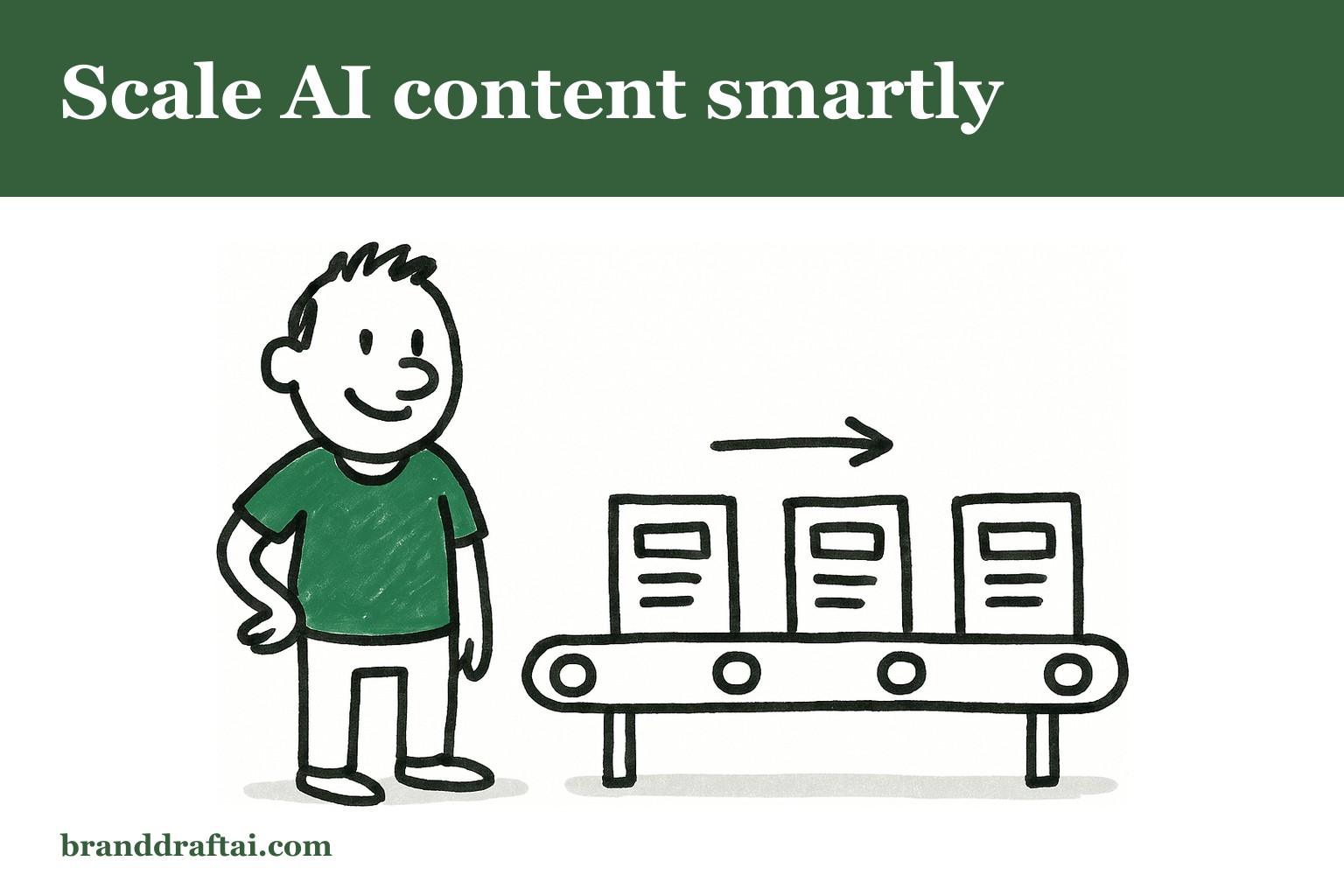

How to scale AI content production without the quality dropping at volume
The request was for 50 blog articles by Friday. The brief included brand guidelines, product descriptions, and a content calendar with specific keywords for each piece. The writer delivered on time , and every article sounded like it came from the same template factory.
This is where AI content production hits its first wall. Not the obvious one where quality drops because you're rushing. The subtler problem where AI content production at volume starts sounding indistinguishable from itself, no matter how good the individual pieces were at the beginning.
The issue isn't speed or even consistency. It's that most scaling approaches treat content like manufacturing widgets instead of communication that needs to sound like it came from somewhere specific.
The Volume Problem Nobody Talks About
Small batches of AI content can sound decent. The tool has fresh context, you're paying attention to each piece, and the topics are different enough that repetition doesn't show up immediately.
Scale that to 20, 50, 100 pieces, and patterns emerge that weren't visible at small volume. The same transition phrases start appearing. Similar opening structures repeat. The voice flattens into something that sounds professional but generic , like elevator music for content.
Content Marketing Institute research found that 72% of businesses producing high-volume content reported quality consistency as their primary challenge. The businesses that solved it weren't the ones with better AI tools — they were the ones that documented their brand context well enough to use it as a consistent input.
The real problem isn't that each individual piece is bad. It's that they start sounding like variations of each other instead of content from a business with a specific point of view.
Why Standard Quality Control Fails at Volume
Most teams approach this by creating style guides and editing checklists. Review every piece for brand voice. Check for keyword density. Verify the facts. Polish the rough edges.
This works until volume makes individual review impossible. You're producing content faster than humans can meaningfully evaluate it, so quality control becomes pattern matching: does this look like the good stuff we produced before?
The answer is usually yes , and that's the trap. Volume content can match surface-level patterns while missing the underlying substance that made the original pieces effective.
You end up with content that passes every checklist item but doesn't sound like it came from anyone in particular. It's branded but not specific. Professional but not memorable.
The Foundation: Context That Travels
Content that maintains quality at volume needs consistent access to what makes the business distinctive , not just brand colours and approved terminology, but the actual products, services, and perspective that separate this company from others in the industry.
Most AI tools generate from generic industry knowledge plus whatever context you provide in each individual prompt. Scale that approach, and the context gets diluted. Each piece knows less about the business than the one before it.
The alternative is tools that read your existing content first , website copy, product descriptions, previous articles that worked. BrandDraft AI fixes this at the input level — it reads your website before generating anything, so the article knows your real product names, not just what businesses like yours usually call things.
This isn't about feeding the same information into every prompt. It's about the tool starting from what your business actually does rather than what businesses in your industry typically do.
Batch Planning That Prevents Pattern Fatigue
Volume content fails when every piece gets generated the same way. Same prompt structure, same content type, same approach to the topic.
Smart batching means varying the content creation process intentionally. Mix long-form articles with shorter pieces. Alternate between educational content and case studies. Change up the prompt style between batches.
One batch might focus on practical how-to content with step-by-step structures. The next batch could be more analytical, looking at industry trends through your company's specific lens. The third could be problem-focused, starting with customer pain points.
This prevents the tool from settling into patterns that show up across multiple pieces. Each batch has its own approach, which means the collection sounds like it came from a business with range rather than a content machine with limited settings.
The Hidden Quality Killer: Topic Clustering
Here's what happens when you're not paying attention to topic distribution: you end up with 15 articles about email marketing, 12 pieces on social media strategy, and 8 different takes on content calendars.
Each individual article might be fine. Together, they reveal that you're generating content topics the same way every time , probably from keyword research tools that suggest similar variations on popular terms.
Quality at volume requires topic diversity that reflects how your business actually helps customers. Not just covering industry keywords, but addressing the specific situations where your product or service becomes relevant.
Map your customer journey and create content for different stages instead of clustering around search volume. Someone researching solutions needs different content than someone comparing specific options or trying to implement what they've already bought.
Quality Indicators That Scale
You can't manually review every piece at volume, but you can track metrics that indicate quality problems before they become obvious.
Content engagement patterns tell the story. If time-on-page drops across multiple recent articles, something changed in the writing quality. If social shares decrease, the content might be getting less memorable. If internal link clicks fall off, readers aren't finding the content compelling enough to explore further.
Track language diversity within your content batches. Tools like Hemingway Editor can flag when sentence structures become too repetitive across pieces. If every article has the same reading level and similar sentence length patterns, variation is probably decreasing.
Most importantly, monitor for phrase repetition across articles. The same transitions, openings, or conclusions appearing in multiple pieces signals that the generation process has settled into patterns that work individually but become obvious at volume.
When Volume Actually Improves Quality
Done correctly, producing more content can make each individual piece better , not worse. More volume means more data about what works for your specific audience and business.
Track which topics generate the most engagement, which writing styles get shared more often, and which content formats drive the most conversions. Use that information to refine your approach for subsequent batches.
Volume also creates opportunities for content that connects across pieces. Reference previous articles when relevant. Build on ideas that worked in earlier content. Create series that develop concepts over multiple pieces instead of trying to contain everything in individual articles.
This only works if you're treating volume content as a learning system rather than a production line. Each batch should be slightly better informed than the one before it.
The Reality Check
Scaling AI content production without quality loss requires acknowledging that most quality problems at volume aren't technical , they're strategic. The tool can only work with the context and approach you provide.
Generic inputs create generic outputs, whether you're producing five articles or fifty. Specific context, varied approaches, and systematic learning from what works creates content that gets better as you produce more of it.
The companies succeeding at volume content treat it as scaling communication, not just increasing output. The difference shows up in every piece they publish.
Generate an article that actually sounds like your business. Paste your URL, pick a keyword, read the opening free.
Try BrandDraft AI — $9.99