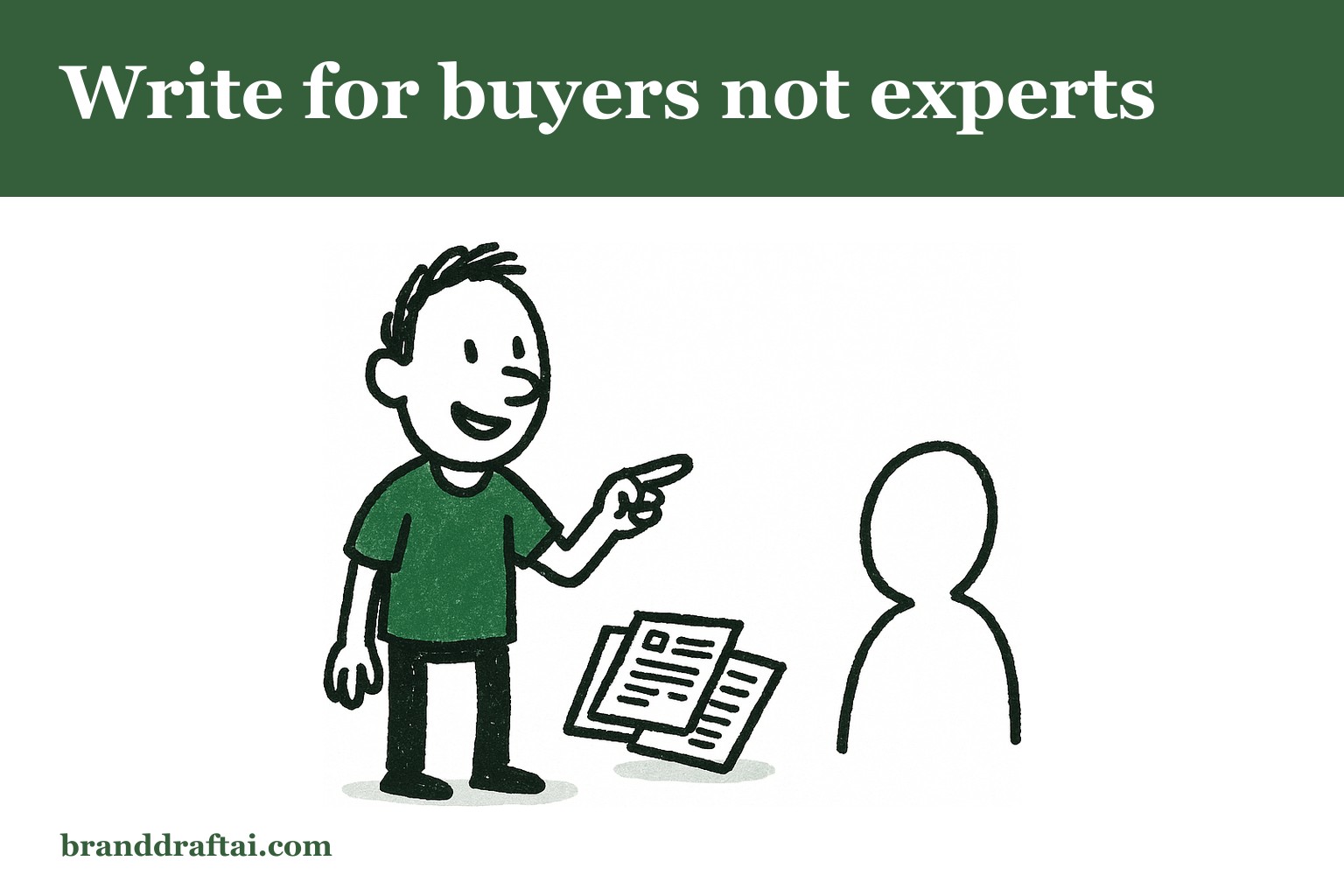

Why B2B content that sounds like your industry loses to content that sounds like your buyer
The SaaS vendor's blog talked about "leveraging synergistic solutions to optimise enterprise workflows." The buyer's internal email said "we need something that stops these goddamn spreadsheets from breaking every month." Guess which voice wins when procurement reviews vendors.
Every B2B category splits into two languages: the one insiders use to sound credible to each other, and the one buyers use to describe their actual problems. Most content chooses the first because it feels safer , who wants to sound unsophisticated? But that choice costs deals.
Industry language signals you belong. Buyer language signals you understand. In almost every B2B sale, understanding beats belonging.
Why industry speak backfires with real prospects
Marketing automation platforms write about "nurture sequences" and "lead scoring algorithms." The VP of Sales calls it "the thing that stops good leads from disappearing into the CRM black hole." She's not wrong , she's just describing the outcome instead of the feature.
Industry language creates a translation problem. Every sentence forces the buyer to work harder, converting your polished terminology back into their messy reality. They read "automated workflow optimisation" and have to think "oh, like when Sarah doesn't have to manually update twelve different systems when someone requests a demo."
That cognitive load adds up. The buyer starts skipping paragraphs. They can tell you know the technical details, but they can't tell if you know their world.
And yes, this feels risky , talking like your buyer instead of your industry peers means some content won't impress other vendors at trade shows. That's the honest trade-off.
The CFO test reveals everything
Put any piece of B2B content in front of someone's CFO and ask: "What problem does this solve for us?" If they can't answer in ten seconds, the language is wrong.
CFOs don't think in features or capabilities. They think in line items that go up or down, people who work late or go home on time, processes that break or run quietly. When cybersecurity content talks about "threat vectors" and "attack surfaces," the CFO hears noise. When it talks about "the call you don't get at 3 AM because systems stayed up," they hear math.
This isn't about dumbing anything down. It's about starting where your buyer starts: with their Thursday afternoon crisis, their quarterly review anxiety, their "please tell me this is the last vendor meeting" exhaustion.
Good buyer language sounds less impressive and works better
Compare these two ways to describe the same HR software:
Version A: "Our comprehensive talent management platform integrates seamlessly with existing HRIS infrastructure to deliver end-to-end employee lifecycle optimisation."
Version B: "Stop losing good people because you found out they were unhappy during their exit interview."
Version A sounds like HR software. Version B sounds like it knows what the VP of People thinks about during her commute. She's not thinking about talent management platforms , she's thinking about Jennifer from accounting who just quit without warning and took half the month-end process knowledge with her.
BrandDraft AI reads your actual website copy before generating anything, so the content references your specific products and terminology while still translating them into buyer language. The output doesn't just avoid generic industry speak , it connects your exact offering to their exact problem.
The subscription trap hiding in plain sight
B2B buyers subscribe to industry publications, follow thought leaders, attend conferences. They know the vocabulary. So why not use it?
Because knowing the language doesn't mean trusting it. Gartner's B2B buying journey research found that 77% of B2B buyers describe their last purchase as "extremely complex" or "difficult" — and part of that difficulty comes from vendor content that sounds authoritative but doesn't speak to their specific situation.
The buyer reads "digital transformation" and thinks "expensive consulting project that might not work." They read "we're struggling to track which marketing actually brings in customers" and think "finally, someone who gets it."
When buyer language goes wrong
Buyer language isn't just casual language. It's not about saying "awesome" instead of "exceptional" or throwing in "guys" every paragraph. Bad buyer language sounds like a 45-year-old trying to text like a teenager , accurate words, wrong rhythm.
Real buyer language reflects how they actually think about the problem. It uses their internal shortcuts, their frustration patterns, their moment of clarity when they realize something has to change. It's specific to their role and their Tuesday morning reality.
Generic casual language sounds fake because it tries to be relatable without actually relating to anything specific. "We know business is tough these days" could apply to anyone. "We know you're tired of explaining to your CEO why the same report takes three people four days to create" applies to someone exact.
The credibility paradox that trips up smart marketers
Here's what makes this hard: buyer language often sounds less credible to the people creating the content. Marketing teams worry they'll seem unprofessional. Sales engineers worry they'll oversimplify. CEOs worry they won't sound like industry leaders.
But credibility with buyers works differently than credibility with peers. Peers judge you for knowing their language. Buyers judge you for knowing their problem. Those aren't the same thing.
The marketing manager who writes about "attribution modeling" sounds smart to other marketing managers. The one who writes about "figuring out which campaigns actually pay for themselves" sounds useful to the CMO who has to explain budget allocation in next week's board meeting.
Or more accurately , it's not that industry language kills credibility, it's that buyer language builds trust faster.
What changes when you make the switch
Content that sounds like buyers gets shared differently. Instead of "check out this thought leadership piece," it gets forwarded with "this is exactly what we were talking about in the budget meeting." The buyer becomes your advocate because you said what they couldn't quite articulate.
Sales calls start differently too. Instead of "I saw your white paper about enterprise solutions," it's "I saw your thing about the spreadsheet problem , that's literally what happened to us last quarter." The conversation skips the education phase and goes straight to fit.
The metrics shift. Time on page goes up because people don't have to decode what you mean. Bounce rate drops because the first paragraph passes the "this is for me" test. Lead quality improves because the content naturally filters for people who actually have the problem you solve.
This doesn't mean abandoning industry expertise or technical accuracy. It means leading with the buyer's problem and supporting with your industry knowledge, not the other way around. The technical details still matter , they just come after you've established that you understand what Tuesday morning feels like in their world.
Generate an article that actually sounds like your business. Paste your URL, pick a keyword, read the opening free.
Try BrandDraft AI — $9.99