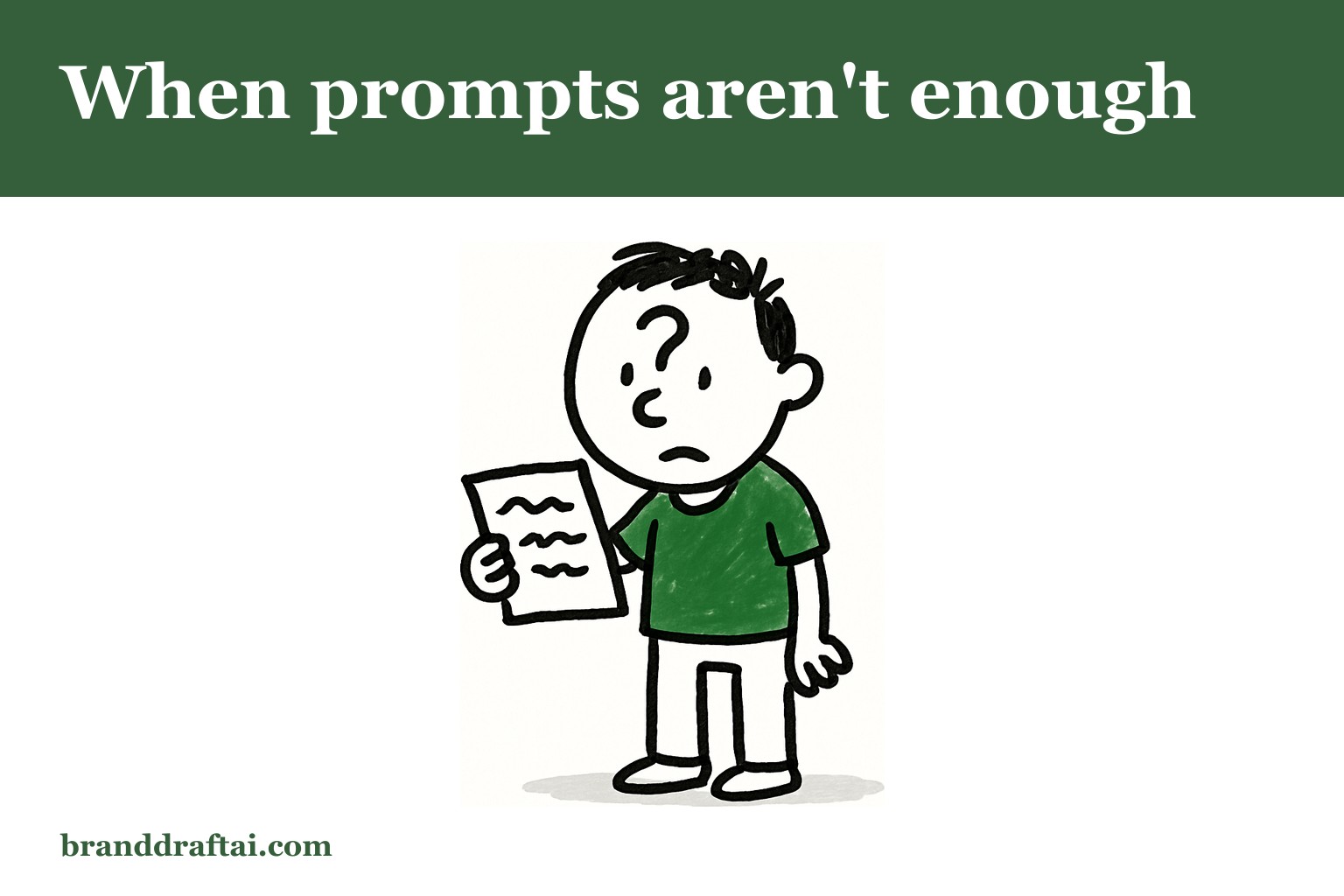

The brand voice problem that no AI prompt can fix on its own
The brief said "approachable but professional, like we're talking to a friend who happens to be an expert." The AI wrote fourteen paragraphs that sounded like a LinkedIn thought leader having a mild caffeine crash. Every sentence hit the same notes , warm, knowledgeable, slightly inspirational , with the emotional range of elevator music.
This happens because brand voice isn't just personality traits listed in a prompt. It's dozens of micro-decisions about word choice, sentence rhythm, and when to break your own rules. You can tell AI your brand is "conversational and confident," but that description covers everything from a local bike shop to a Fortune 500 consulting firm.
The problem isn't that AI can't write in different voices. It's that voice emerges from specificity, and most prompts stay generic even when they're trying not to be.
Why describing voice isn't the same as demonstrating it
Here's what usually gets included in brand voice prompts: tone adjectives (friendly, professional, authoritative), audience description (busy executives, small business owners), and maybe a "don't sound too corporate" instruction. The output follows these guidelines perfectly and sounds like nothing.
Real brand voice shows up in the details. A plumbing company that says "your water heater threw a tantrum" instead of "your water heater malfunctioned." A marketing consultant who writes "most agencies will hand you a 47-slide deck about synergy" instead of "many agencies focus on strategy." An accounting firm that opens emails with "your books look good, your cash flow has opinions."
These aren't personality traits you can capture in adjectives. They're specific ways of seeing and describing the world that emerge from actually knowing the business.
And yes, you could try to include these examples in your prompt , but then you're writing the content yourself to teach AI how to write content for you.
The reference problem every business faces
AI doesn't know your product is called the ProFlow System, not "our innovative plumbing solution." It doesn't know your customers are contractors who buy in bulk, not "valued clients seeking quality products." It doesn't know you call the installation process "setup" while your industry calls it "deployment."
This creates content that's technically accurate but sounds like it was written by someone who spent twenty minutes on your website. Because that's exactly what happened.
The gap shows up everywhere. Blog posts that reference "solutions" when you sell specific software modules with actual names. Social media captions that talk about "our team" when your business page clearly shows it's a solo operation. Email sequences that assume a formal relationship when your existing customers text you directly.
What AI actually needs to write like your business
Voice isn't performance , it's the natural result of knowing what you're talking about. When someone understands your business, they automatically use your terminology, reference your actual products, and write from the perspective of someone who's been in those customer conversations.
This is why brand voice guidelines often fail. They describe the effect (sound approachable) without providing the cause (deep familiarity with how this specific business works). AI needs context, not coaching.
The most effective brand voice work happens when AI reads your existing content first , not just the About page, but customer emails, product descriptions, support tickets, sales calls. BrandDraft AI reads your website content before generating anything, so it references actual product names and company-specific language instead of generic industry terms.
It's the difference between being told "write like a friendly expert" and actually becoming familiar with how this particular expert talks about their work.
Why generic prompts create generic voice
Most brand voice instructions read like this: "Write in a conversational tone that's professional but not corporate. Be helpful and knowledgeable. Speak to small business owners who are busy and want practical advice."
That describes approximately 60% of B2B content on the internet. The AI follows every instruction and produces something that could have been written for any business in any industry.
Compare that to: "Write for restaurant owners who run family businesses, work 70-hour weeks, and need solutions they can implement between lunch and dinner rush. Reference the reality that they're often choosing between fixing the walk-in cooler or updating their POS system, not debating enterprise software features."
The second version isn't just more specific , it contains the worldview that creates authentic voice. It knows what these business owners actually think about, how they make decisions, and what language resonates because it reflects their daily reality.
When voice guidelines actually work
Effective brand voice guidance focuses on perspective, not personality. Instead of "sound confident," try "write from the position of someone who's solved this problem fifty times and knows where clients usually get stuck." Instead of "be conversational," try "acknowledge the practical constraints , budget, time, staff capacity , that affect every decision."
The best voice prompts include specific scenarios. Not "write for marketing managers" but "write for marketing managers at companies where they're the entire marketing department, handling everything from email campaigns to trade show logistics."
This type of specificity naturally creates consistent voice because it gives AI the same knowledge base a human writer would need to sound credible and relevant.
The demonstration gap that trips up most businesses
You know your brand voice when you hear it, but describing it in a prompt is like trying to explain humour , the description rarely captures what makes it work. A restaurant might know their social media voice is "like talking to regulars at the bar," but translating that into AI instructions usually produces something much flatter.
The problem compounds when businesses try to describe voice without showing examples from their existing content. AI learns better from patterns than from descriptions, but most prompts stick to abstract guidance.
This is where reading existing content becomes critical. If AI can see how you actually write emails to customers, describe your services, and handle common questions, it picks up the voice patterns naturally , the way a new employee absorbs company culture by watching how everyone else communicates.
What changes when voice becomes automatic
When AI actually knows your business context, voice stops being something you have to engineer in every prompt. The output naturally sounds like your company because it's working from your actual terminology, customer knowledge, and business reality.
Content starts feeling consistent across formats — blog posts, emails, social media — because it's coming from the same knowledge base rather than trying to follow abstract personality guidelines. Mailchimp's voice and tone guide was built on exactly this insight: the guide isn't the voice — the existing content is the voice. The guide just makes it findable for anyone who needs to write something new.
Most importantly, you stop spending time fixing voice issues in every draft. When AI knows your business well enough, voice becomes automatic rather than something you have to correct after the fact.
The goal isn't perfect brand voice in every sentence. It's AI that knows your business well enough that the voice emerges naturally from that knowledge, the same way it would for any human writer who actually understood what you do.
Generate an article that actually sounds like your business. Paste your URL, pick a keyword, read the opening free.
Try BrandDraft AI — $9.99