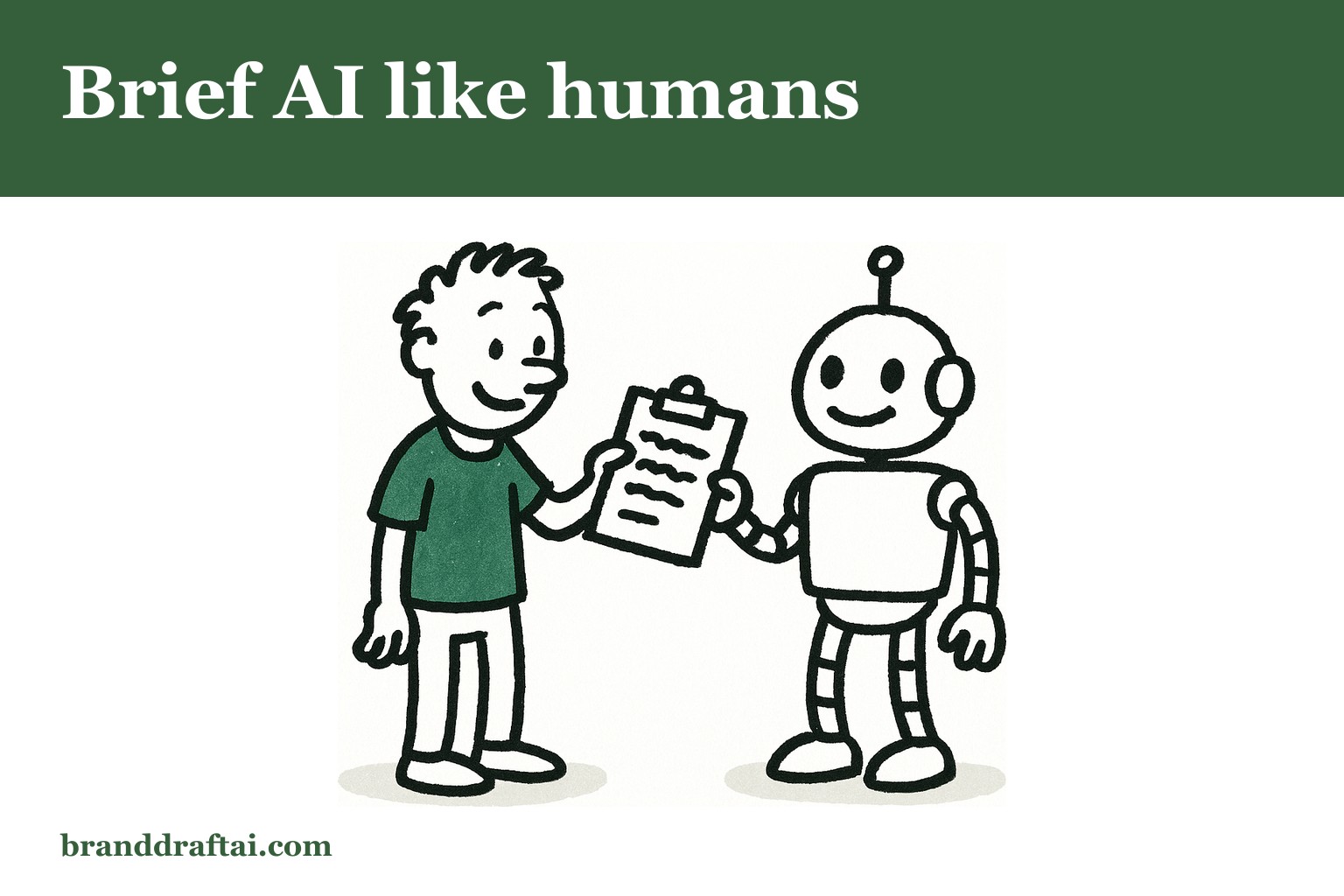

How to brief an AI tool the way you'd brief your best writer
The email said "write about our cybersecurity platform" with a link to the homepage. Twenty minutes later, you're staring at five paragraphs that could describe any security company in North America. The client will read it, frown, and ask for "something that sounds more like us."
Most people brief AI writing tools the same way bad clients brief writers , with the topic and a prayer. Then they wonder why the output sounds like it came from a template factory.
Here's what changed when I started treating AI prompts like proper creative briefs. And why the difference shows up in the first sentence.
What Your Best Writer Would Ask First
A good writer doesn't start typing after hearing the topic. They ask questions that sound obvious but aren't: Who's this for? What do they already know? What should they think differently after reading?
The brief that produces sharp writing contains three things most AI prompts skip entirely. First, the specific reader , not "business owners" but "SaaS founders who've hired their first marketing person and need content that doesn't sound like every other startup." Second, the gap you're filling , what misconception, missing piece, or unasked question does this address? Third, the voice , not "professional and engaging" but "peer talking to peer, confident but not cocky, willing to take a position that might be wrong."
Watch what happens when you brief with that level of detail. The AI stops reaching for generic business language because you've given it something specific to be.
Why "Write About X" Produces Commodity Content
Topic-only prompts force AI into pattern-matching mode. It scans for the most common way this subject gets discussed, finds the standard structure, and fills it in with standard language.
You get articles that hit every expected point while saying nothing memorable. The introduction explains why the topic matters. The body covers the obvious angles. The conclusion restates everything in slightly different words. Perfect template execution. Zero personality.
The problem isn't the AI , it's working with what you gave it. Feed it a generic brief, get generic output.
What Separates Professional Briefs From Topic Dumps
Real creative briefs start with constraints, not permissions. They narrow the focus until there's only one way to approach the piece that makes sense.
A professional brief includes the business context the writer needs to sound credible. Not just "we sell project management software" but "we sell project management software to construction companies who've been using spreadsheets and need something that doesn't require training their crew on seventeen new features." The specificity gives the writing somewhere to land.
It also includes what not to say. The topics that have been covered to death, the angles that don't work for this audience, the voice that definitely isn't right. Good briefs eliminate options as much as they create them.
And yes, this takes longer upfront , that's the honest trade-off. But compare thirty minutes writing a proper brief to three hours trying to edit generic output into something that sounds like your business.
The Information That Actually Changes AI Output
Context about your audience changes everything. Not demographics , behaviours. How do they currently solve this problem? What have they already tried? What assumptions do they bring that you need to work with or around?
Your actual product details matter more than you think. Not marketing copy , the specific names, features, and limitations that make your business different from the template version in the AI's training data. This is where tools like BrandDraft AI earn their place by reading your website before generating anything, so the output references actual product names instead of generic industry language.
The competitive landscape shapes the piece as much as the topic does. If everyone in your space talks about efficiency, maybe your angle is precision. If the standard approach is comprehensive overviews, maybe you write narrow deep-dives.
Voice Instructions That Actually Work
"Professional but approachable" tells the AI nothing useful. It's the creative equivalent of asking for "something good."
Voice instructions that change output get specific about decisions. Should this acknowledge uncertainty or project confidence? When the reader disagrees, do you acknowledge their position or push back? Do you explain concepts from scratch or assume some knowledge?
Reference actual examples when possible. Not "write like a consultant" but "write like the McKinsey articles that don't sound like McKinsey , direct, practical, unafraid to tell clients they're doing something wrong." The AI can match patterns it recognises.
Why Brand Context Makes Everything Click
The best writing sounds like it came from someone who understands the business from the inside. That means including the details that only you would know , the customer questions that come up repeatedly, the industry assumptions that your experience has proven wrong, the practical constraints that textbook advice ignores.
This context shows up in small ways that compound. Instead of "businesses struggle with data management," you get "manufacturers using three different inventory systems discover their data conflicts when they try to forecast demand." Same concept, completely different credibility.
Brand voice isn't just tone , it's the specific knowledge and perspective that makes your content irreplaceable by template alternatives.
When Good Briefs Go Wrong
Over-briefing kills the output as much as under-briefing does. The AI starts trying to satisfy twelve different requirements and loses focus completely.
The most common mistake is conflicting instructions. Asking for "comprehensive but concise" or "expert-level but accessible to beginners" creates impossible requirements. Pick one priority and let everything else support it.
Another trap: briefing for the piece you think you should write instead of the piece your audience actually needs. If your readers are three months into researching a solution, they don't need "what is [category]." HubSpot's search intent research found that content matching the exact stage of the buyer's journey — not the topic they're researching — converts at two to three times higher rates than content addressing the topic generally.
The Test That Reveals Everything
Good briefs produce output that sounds like it came from someone familiar with your business. Bad briefs produce content that could have been written for any company in your industry after ten minutes of Wikipedia research.
If you handed the output to a competitor and they could publish it with minimal changes, the brief wasn't specific enough. If the piece includes details that only your customers would recognise, the brief worked.
The writing should feel inevitable , like this was the only way to approach the topic given everything the brief contained. When that happens, you're not editing content. You're just publishing it.
Generate an article that actually sounds like your business. Paste your URL, pick a keyword, read the opening free.
Try BrandDraft AI — $9.99