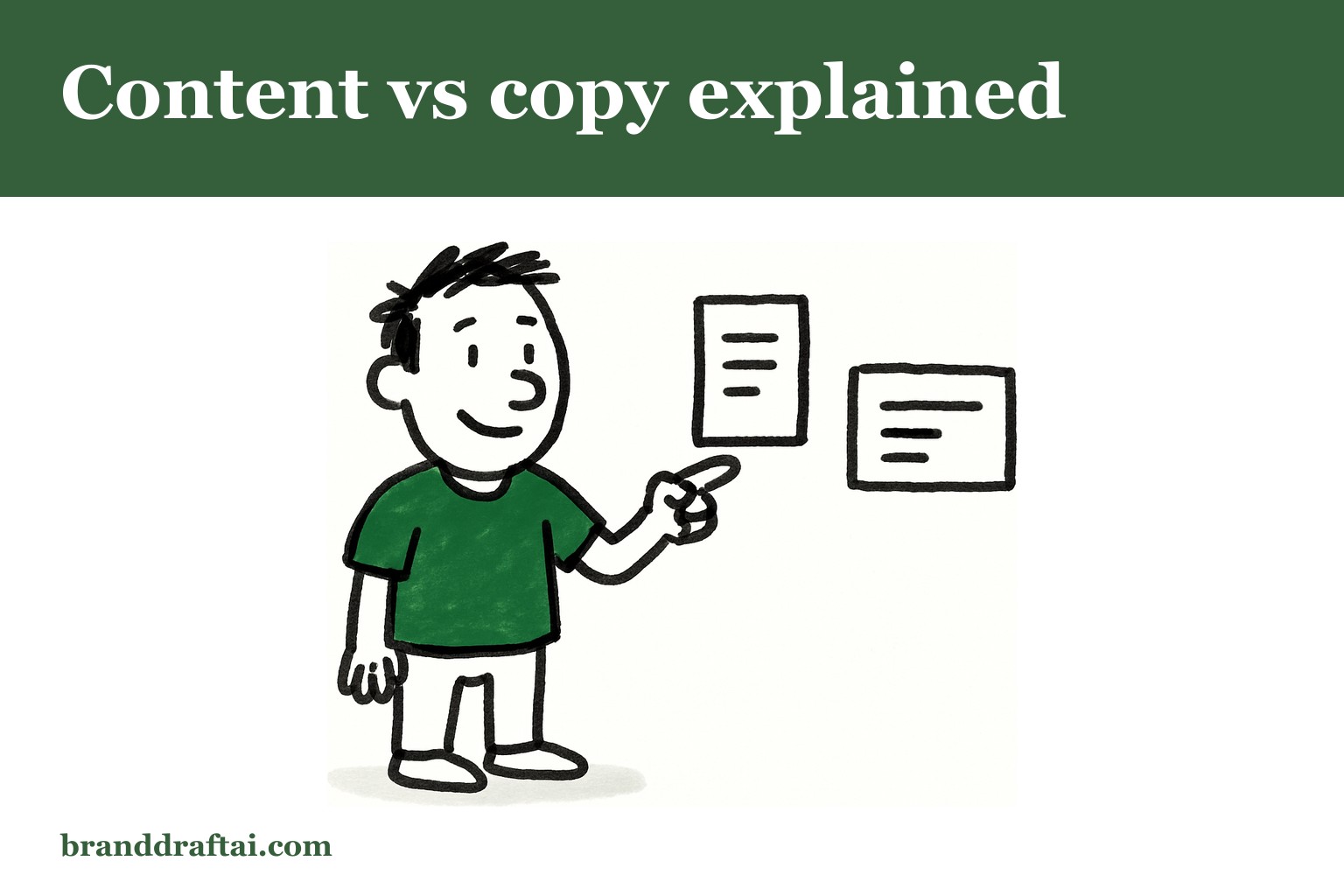

Content writing vs copywriting — what's the difference and which do you need
The project brief landed Monday morning: "We need someone to write marketing copy for our new product launch." By Thursday, you're reading a 2,000-word educational article about industry best practices. The client wanted sales copy. You delivered thought leadership.
Or the opposite happens. The content calendar called for "helpful blog posts to build trust with prospects." What showed up reads like a series of product brochures with question marks added to the headlines.
Content writing and copywriting aren't interchangeable job descriptions with different names. They solve different business problems, require different skills, and produce different results. Mixing them up doesn't just waste budget , it actively works against what you're trying to accomplish.
What content writing actually does
Content writing builds relationships before anyone's ready to buy. It answers questions, explains concepts, and demonstrates knowledge without asking for anything in return. The reader finds your article through search, reads it because it helps them understand something, and leaves with a better impression of your business.
Good content writing feels like getting advice from someone who knows what they're talking about. The writer researches thoroughly, presents information clearly, and trusts that being useful will eventually pay off. Content Marketing Institute tracks this conversion timeline consistently — organic content typically takes six to twelve months to produce measurable pipeline, compared to days for copy-driven campaigns.
Content writing succeeds when readers share it, bookmark it, or reference it later. The conversion happens months down the line, if at all. You can't always trace a blog post directly to a sale, but you can track whether people are finding and engaging with your ideas.
What copywriting actually does
Copywriting asks for immediate action. It identifies what's stopping someone from buying and addresses that specific hesitation. Every sentence moves toward a decision , sign up, schedule a call, add to cart, download the guide.
The best copywriting doesn't feel like persuasion because it speaks directly to what the reader already wants. It connects their current frustration to the solution you're offering. The language is precise, the benefit is clear, and the next step is obvious.
Copy succeeds when people act on it. Click rates, conversion rates, response rates , the metrics are immediate and trackable. A great sales page can be measured by how many prospects it turns into customers. A great email campaign shows results in the first 24 hours.
Why the confusion happens so often
Both involve writing for business purposes. Both require understanding your audience. Both can be published on websites, in emails, and on social media. The surface similarities make it easy to assume they're the same job with different terminology.
The real difference lives in the timeline and the goal. Content writing optimizes for search rankings and long-term trust building. Copywriting optimizes for immediate response and conversion. One plants seeds, the other harvests them.
And yes, some projects genuinely need both. A product launch might require educational content to build awareness and sales copy to convert interest into purchases. But you still need to know which outcome each piece is supposed to produce.
When your business needs content writing
Your prospects don't know you exist yet, or they know your name but not what you do differently. You're competing with established players who own the first page of search results for your industry keywords. Your sales team keeps hearing the same questions that could be answered upfront.
Content writing works when the buying process is complex or high-consideration. B2B software purchases, professional services, major consumer purchases , decisions that involve research, comparison shopping, and multiple stakeholders. The buyer needs to understand the problem before they're ready to evaluate solutions.
You need content writing if your business depends on being found through search. People are looking for answers to questions related to your product or service, but they're not searching for your company name specifically. Educational content intercepts those searches and introduces them to your brand.
When your business needs copywriting
You have traffic but conversions are low. People visit your website, read your content, maybe even engage on social media, but they're not taking the next step. The awareness is there but something's blocking the decision.
Copywriting works for direct response situations. Email campaigns promoting limited-time offers. Landing pages for paid advertising traffic. Sales pages for products with clear, immediate benefits. Any situation where someone has enough information to decide and just needs the right nudge.
You need copywriting if your business model depends on fast conversions. E-commerce, SaaS free trials, event registrations, lead magnets , scenarios where the gap between interest and action should be measured in minutes, not months.
Your existing customers love what you do, but explaining it to new prospects feels impossible. This often signals a copywriting problem. The value is real, but the way you're describing it isn't connecting with how people think about their problem.
What happens when you choose wrong
Hiring a content writer to create sales copy usually produces educational articles that never ask for the sale. The writing is informative and well-researched, but it doesn't move anyone toward a purchase. Traffic might increase, but leads don't. HubSpot's content marketing research documents this consistently.
Hiring a copywriter to produce content often results in articles that sound like extended advertisements. Every paragraph builds toward a pitch. The tone is persuasive rather than helpful. Search engines and readers both recognise this approach and respond accordingly.
The timing mismatch creates the real damage. Content writing published when you need immediate conversions wastes the window of opportunity. Copywriting published when you need relationship building can damage trust with prospects who aren't ready to buy yet.
Tools like BrandDraft AI help bridge this gap by analysing your actual website and business details before generating anything, so the output matches your specific products and terminology whether you're creating educational content or direct-response copy.
How to brief either one correctly
Start with the business goal, not the content format. "We need blog posts" tells a writer almost nothing useful. "We need to capture search traffic from people researching alternatives to our main competitor" gives them direction.
For content writing: Specify the audience's knowledge level and where they are in the buying process. Share the questions your sales team hears repeatedly. Identify the keywords you want to rank for, but explain why those terms matter to your business.
For copywriting: Define the specific action you want readers to take and what's currently preventing them from taking it. Share objections from real prospects. Provide examples of messages that have worked in other contexts , emails, sales calls, presentations.
Both types of writers need access to your actual customers and their language. The best content and copy sounds like your audience talking about their problems, not like your industry talking about itself. Screenshots of customer support tickets, sales call recordings, and feedback surveys matter more than brand guidelines.
The skill sets overlap but they're not identical. Someone who writes compelling sales emails might not have the research skills and SEO knowledge to create educational content that ranks. Someone who produces thorough, well-structured articles might not know how to write subject lines that get opened.
Most businesses need both, just not for every project. Know which problem you're solving first, then find the writer who specialises in that type of solution.
Generate an article that actually sounds like your business. Paste your URL, pick a keyword, read the opening free.
Try BrandDraft AI — $9.99