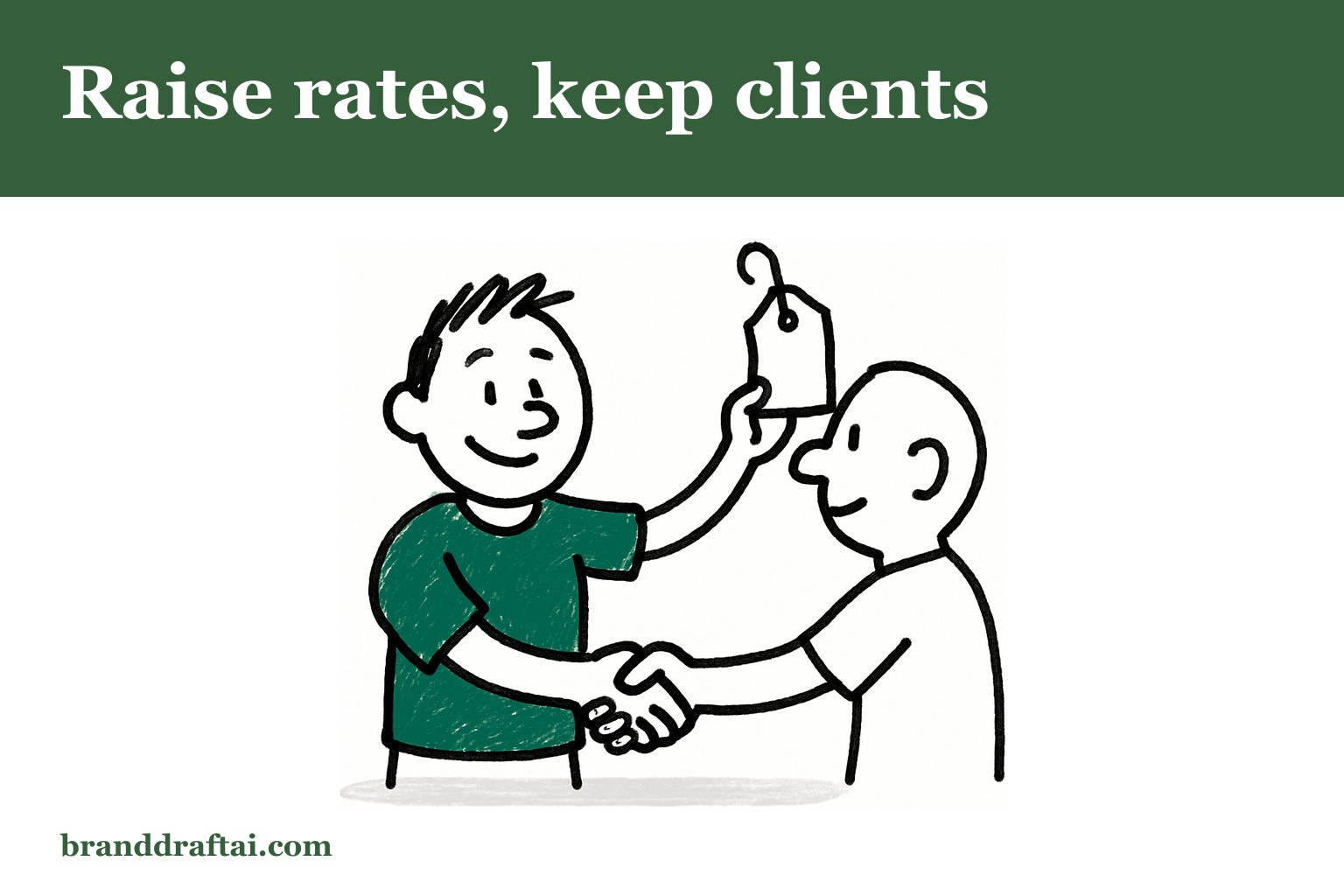

How to increase your freelance writing rates without losing clients
The email sat in your drafts folder for three weeks. "I wanted to discuss adjusting my rates for our upcoming projects." Delete. "Due to increased costs..." Delete. "After two years of working together..." Delete.
You're not alone in this particular form of professional paralysis. The gap between what you need to charge and what you're actually charging grows wider each month, but the conversation feels impossible to start.
Here's what most freelancers get wrong: they think rate increases are about justifying higher prices. They're actually about repositioning the relationship around value you're already providing but not getting paid for.
The Real Problem With Most Rate Increase Conversations
Most writers approach rate increases like they're asking for a favour. They apologize for the inconvenience, explain their rising costs, promise the same deliverables for more money.
This frames the conversation as "I need more money for the same thing" instead of "you're getting more value than you're paying for." One sounds like your problem. The other sounds like their opportunity.
The clients who push back hardest on rate increases are usually the ones getting the best deal. They know it, which is exactly why they resist change.
Start With Clients Who Already Respect Your Work
Don't practice on your biggest client. Don't start with your most price-sensitive account. Pick someone who consistently praises your work, pays on time, and gives you interesting projects.
These clients already see the value. They're paying below market rate because you set that rate when you had less experience, not because that's what your work is worth now.
The conversation becomes simpler when you're talking to someone who already knows you deliver. You're not selling your ability, just adjusting the price to match what they're receiving.
Document What You Actually Do (Not What You Were Hired to Do)
Track everything for one month. Every revision round, every strategy call, every "quick question" that turned into 30 minutes of consultation. Every piece of research beyond what was in the brief. PWAC's member rate surveys consistently show that writers who raise rates successfully do it after documenting the actual scope of their work — not because they decided they deserved more, but because the numbers made the conversation easy.
Most freelancers discover they're doing 40-60% more work than they're charging for. Not because clients are demanding it , because you evolved into it gradually, project by project.
That research becomes your rate increase justification. Not "I deserve more money," but "here's what you're actually receiving vs. what we originally scoped."
And yes, this documentation takes time you don't have. Track it anyway. The alternative is having this conversation again next year at the same rates.
Why Your Current Rates Might Be Costing You Better Clients
Low rates signal something to potential clients, and it's not "great value." Enterprise clients often eliminate writers below a certain rate threshold because they assume the quality won't match their standards.
The paradox: charging more can actually get you in front of clients who value writing quality. These clients have budgets that match their expectations.
Meanwhile, the clients who fight hardest about your rates are often the same ones who request endless revisions, provide minimal briefs, and treat writing like a commodity. Your rates are attracting exactly the wrong kind of work.
How to Write the Rate Increase Email
Subject line: "Rate adjustment for [specific client name] projects"
No apologies. No lengthy explanations about your costs. Lead with what they're getting: "Over the past year, our projects have evolved to include more strategic consultation and research than we originally scoped."
Be specific about the additional value: "Recent articles have included competitor analysis, multiple rounds of strategic feedback, and consultation on content distribution strategy."
State the new rate clearly: "Starting with projects booked after [date], my rate will be $X per article." Not "I'd like to discuss" or "I'm hoping we can." Just what's changing and when.
End with timeline: "This gives us time to finish current projects at existing rates and plan future work accordingly."
The key is confidence without defensiveness. You're informing them of a business decision, not asking permission for one.
What to Do When Tools Change Your Value Proposition
AI writing tools created a weird situation for freelancers. Some clients expect lower rates because "AI can do it faster now." Others want higher quality because they've seen what generic AI output looks like. For more on this, see our guide to AI content generator for small businesses.
The difference is in how you position yourself. If you're competing on speed and basic content production, AI is a threat. If you're competing on brand-specific knowledge and strategic thinking, AI becomes a tool that makes your expertise more valuable.
BrandDraft AI solves this by reading your website before writing anything — the content references what you actually sell, not what businesses in your category usually sell. When clients see that level of brand alignment, they understand why human oversight and strategy still matter.
But this only works if you've positioned yourself as more than a content producer. If your main value is turning briefs into articles, that's increasingly a commoditized service.
The Clients Worth Keeping vs. Losing
Some clients will say no to your rate increase. That's not a negotiation failure , it's market information.
The clients worth keeping are the ones who either agree immediately or ask about the additional value they'll receive. They're thinking about ROI, not just cost.
The ones worth losing respond with "I can get articles written for half that price." They can, and they should. Those clients will never value strategic thinking, brand knowledge, or quality above cost. Working for them at any rate is a business mistake.
There's a middle group who need time to adjust their budgets. Give them that time. Offer to implement the increase in 60-90 days. Most will make it work because they've already built their content strategy around your contributions.
You'll lose some clients during rate increases. Plan for it. The goal isn't to keep everyone , it's to keep the ones who see the difference between content and communication.
When Rate Increases Actually Backfire
Rate increases fail when your work quality hasn't kept pace with your rate ambitions. If your recent articles sound like everyone else's, if your research is surface-level, if your strategic input adds nothing unique , then yes, clients will balk.
The other failure point: increasing rates without increasing boundaries. If you raise your price but still answer emails at midnight and accept impossible deadlines, you've just created expensive chaos instead of valuable expertise.
Your rates need to reflect not just the quality of your output, but the professionalism of your entire client experience. That includes how you handle revisions, manage project timelines, and communicate about scope changes.
The clients who refuse your rate increase often aren't rejecting your price , they're rejecting the value equation as they experience it. Sometimes that's a client problem. Sometimes it's a you problem. Be honest about which one you're dealing with.
Generate an article that actually sounds like your business. Paste your URL, pick a keyword, read the opening free.
Try BrandDraft AI — $9.99