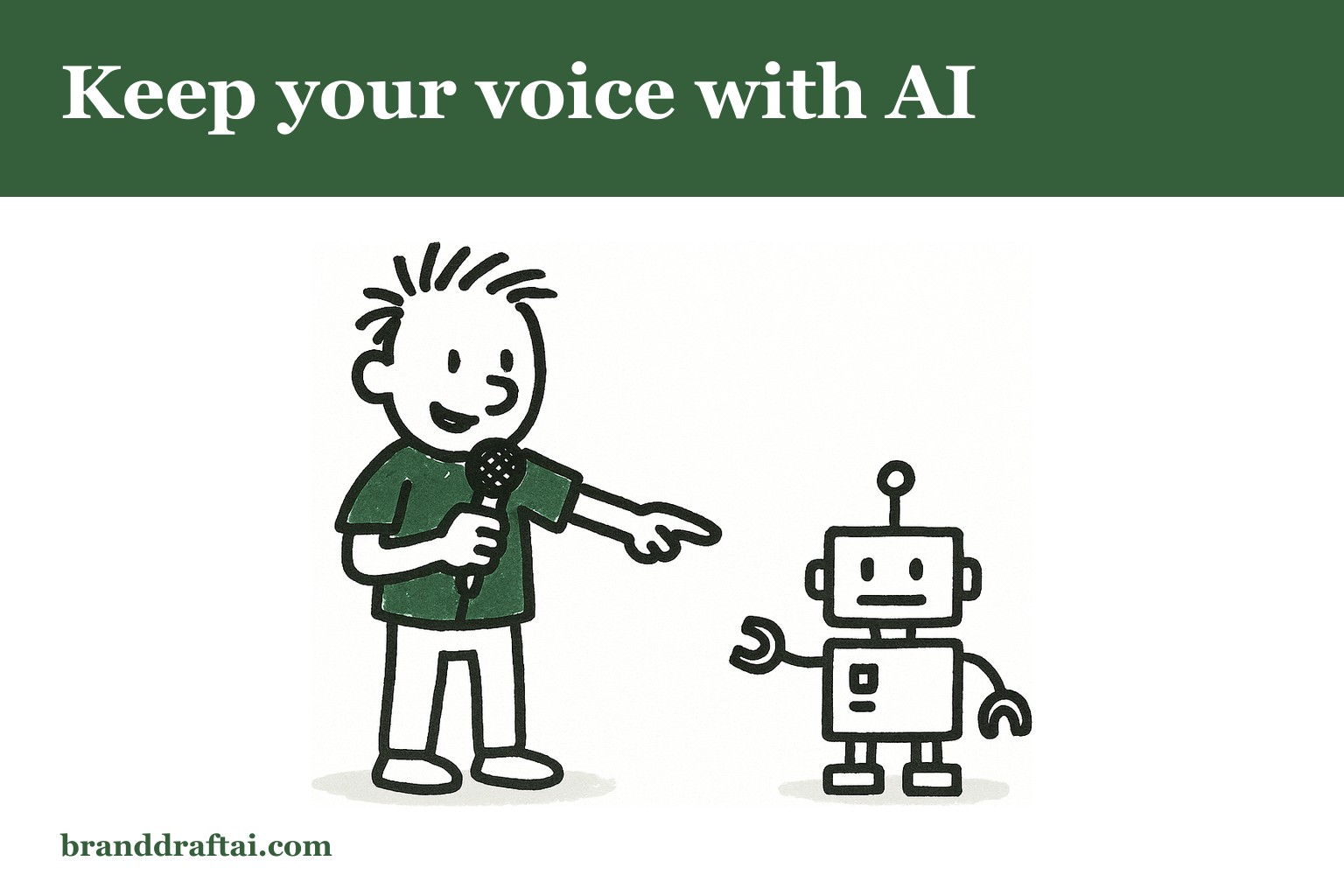

How to maintain your brand voice when using AI to write content
The draft came back using "cutting-edge solutions" three times. Your product isn't a solution , it's a custom inventory management system called TrackFlow. The writer had never seen your website.
This happens because AI tools treat every business like a template. Feed them "write about our software" and they'll generate the same corporate-speak whether you sell accounting software or dog grooming services. The output sounds professional but sterile, like it was written by someone who learned your industry from Wikipedia.
The real problem isn't the AI. It's that most people hand over a topic and expect the tool to figure out their voice from nothing. Maintaining your brand voice when using AI to write content requires feeding the system information about how your business actually talks , not just what you sell.
What AI needs to sound like your business
Generic input creates generic output. Tell ChatGPT to "write about our consulting services" and you'll get consulting industry boilerplate. Tell it you're a lean manufacturing consultant who works with mid-size food processors in the Midwest and only takes on six-month engagements , now it has something specific to work with.
AI writing tools generate content by predicting what comes next based on patterns in their training data. If you don't give them enough specific information about your business, they default to the most common version of whatever category you're in. Mailchimp's content team built their entire voice guide around this problem — the document exists because generic "tone of voice" instructions don't survive contact with an AI that's seen ten thousand similar companies. For more on this, see our guide to AI content generator for small businesses.
The solution isn't better prompts. It's better context. AI needs to know your actual product names, how you explain complex concepts, what your customers call their problems, and which industry terms you avoid. Without this context, even the most sophisticated writing tool will produce content that could have come from any of your competitors.
The brand voice brief that actually works
Most brand voice guides are useless for AI content creation. "We're professional but approachable" doesn't tell the AI whether to write "utilise" or "use." The tool needs concrete examples, not adjectives.
Start with how you actually explain your main product or service in conversation. Record yourself describing what you do to someone who's never heard of your business. Note which words you emphasise, which technical terms you define, and which analogies you use. This becomes your voice foundation.
Document your specific vocabulary choices. Do you call them clients or customers? Projects or engagements? Implementation or rollout? AI tools will default to the most common industry term unless you specify otherwise. And yes, this takes time upfront , but it's the difference between content that sounds like you and content that sounds like everyone else.
Include examples of how you handle common topics. If you write about pricing, do you lead with value or address cost objections directly? When explaining technical features, do you use analogies or stick to specifications? These patterns matter more than tone descriptions.
Why the input phase makes or breaks everything
The first thirty seconds determine whether your AI-generated content will need major rewrites or minor edits. Most people start typing their request immediately. The smart approach is spending those thirty seconds gathering the right background information.
Pull up recent content that sounds like your brand. Look at your website copy, recent blog posts, or sales emails that got good responses. Note the specific phrases and sentence structures that work. AI tools can mirror these patterns if you point them out explicitly.
Include negative examples too. If your industry overuses certain buzzwords, mention which ones to avoid. If your competitors all sound the same way, explain how you're different. BrandDraft AI reads your website before generating anything, so the article knows your specific products, services, and business language before the first sentence is written.
Context matters more than creativity here. The AI doesn't need to invent your voice , it needs enough information to replicate the voice you already have.
The three-layer approach to consistent voice
Layer one is vocabulary. Feed the AI your specific product names, preferred terminology, and industry jargon you actually use. Skip the words that make you cringe when competitors use them.
Layer two is structure. Show examples of how you organise information. Do you start with the problem or the solution? Lead with benefits or features? Use bullet points or paragraph explanations? AI tools mirror the organizational patterns you demonstrate.
Layer three is personality markers , the small choices that make your content recognizably yours. Maybe you use contractions consistently, or you acknowledge downsides honestly, or you explain things with specific examples instead of abstract concepts. Point these out explicitly because they're too subtle for the AI to pick up automatically.
When the output sounds wrong anyway
Even with good input, AI-generated content sometimes misses the mark. The most common problem is tone drift , starting strong but gradually shifting toward generic language as the piece continues.
This happens because AI tools weight recent context more heavily than initial instructions. If your first few sentences use your brand voice but then introduce industry-standard phrasing, the AI will start matching that standard language instead of your voice.
The fix is reviewing your input for mixed signals. If your brief says "conversational tone" but your example content uses formal language, the AI gets conflicting instructions. Clean up the contradiction and the output improves immediately.
Sometimes the problem is asking for content types that don't match your natural voice. If your brand voice is direct and practical, asking for inspirational content will produce awkward results. Work with your voice, not against it.
Building voice consistency across different content types
Your email voice differs from your blog voice, which differs from your social media voice. This isn't inconsistency , it's context-appropriate communication. The challenge is helping AI tools understand these variations.
Create separate voice profiles for different content formats. Your email signature might be formal, but your blog comments can be casual. Document these differences with specific examples rather than trying to force one voice everywhere.
The key is maintaining core vocabulary and personality markers while adjusting formality level. Your product names and key concepts stay consistent, but sentence length and technical detail can vary based on the platform and purpose.
Testing and refining your voice system
Generate a few test pieces using your voice brief, then read them alongside recent content you're happy with. The AI output should feel like it came from the same business, even if it covers different topics.
Pay attention to where the voice breaks down. Are certain types of explanations consistently off? Does the AI default to buzzwords when discussing specific topics? These patterns reveal gaps in your voice documentation.
Refine based on actual output, not theoretical guidelines. If the AI consistently uses "solutions" when you prefer "services," add that specific substitution to your brief. The voice guide evolves as you test it with real content needs.
Most businesses never get past the first draft of their voice brief, then wonder why their AI content sounds generic. The system works when you treat voice documentation as an ongoing process, not a one-time setup.
Generate an article that actually sounds like your business. Paste your URL, pick a keyword, read the opening free.
Try BrandDraft AI — $9.99