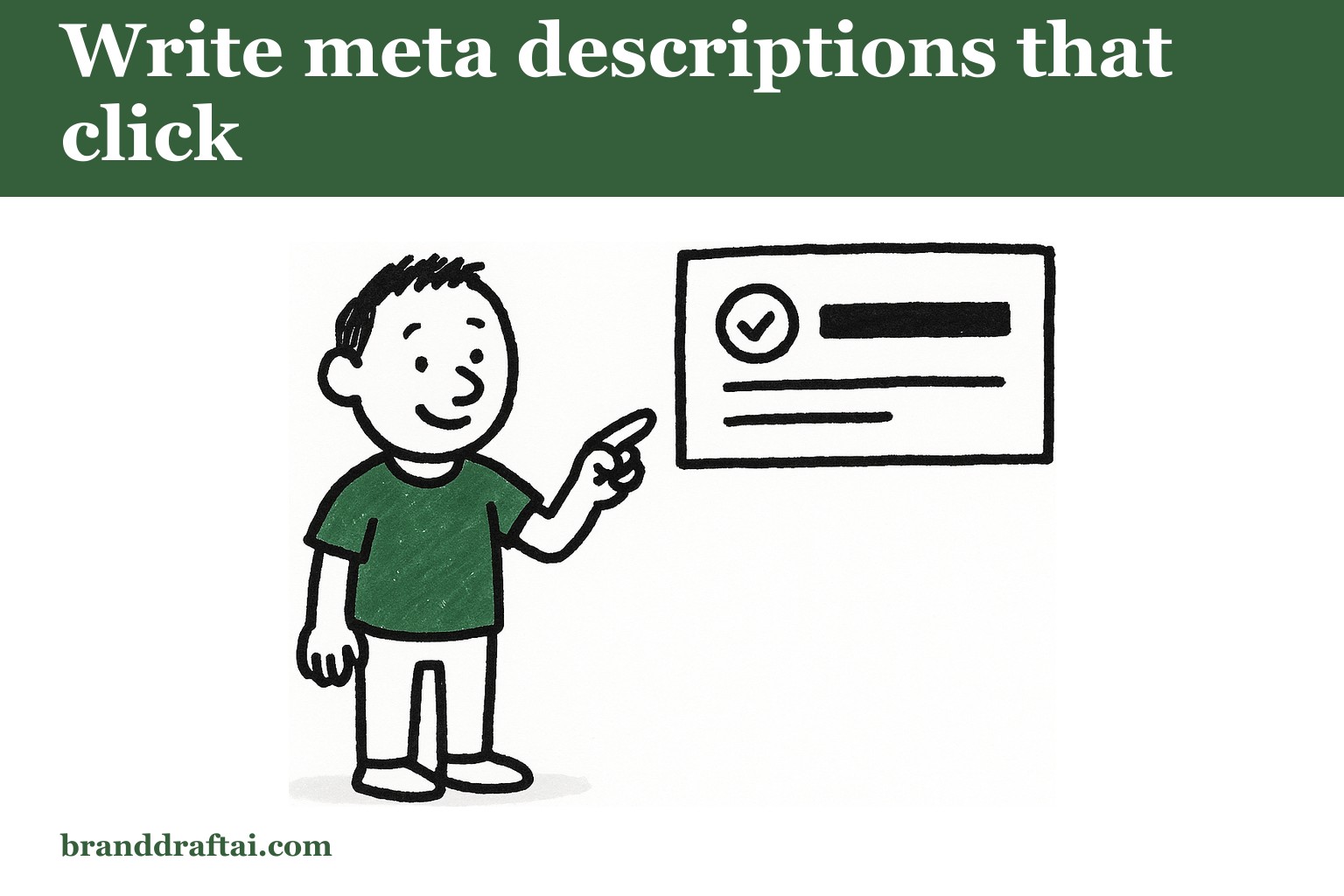

What goes in a meta description that actually gets clicks
The search result preview looked perfect. Click-through rate: 2.1%. The same spot next month with different meta description copy: 4.8%. Same ranking position, same traffic volume, more than double the clicks.
Meta descriptions don't affect where you rank. They affect whether anyone bothers visiting once you do rank. Most get written like afterthoughts , generic summaries that could describe any page about the topic. The ones that work understand they're competing for attention, not explaining content.
Why Most Meta Descriptions Get Ignored
People scan search results in patterns. Eye-tracking studies from Nielsen Norman Group show users spend an average of 2.6 seconds reading each result before deciding whether to click. Your meta description gets a fraction of that time.
The standard advice treats meta descriptions like tiny abstracts: "Summarise your page in 150-160 characters." But abstracts assume someone already decided to read. Search results require a different approach entirely.
Most meta descriptions fail because they describe instead of persuade. "Learn about effective email marketing strategies for small businesses" tells what the page contains. "The email template that gets 47% more replies than the industry average" tells what the reader gets. The first summarises. The second creates a gap. Yoast's research on click-through rates consistently shows that gap-framed descriptions outperform summaries at the same ranking position. For more on this, see our guide to AI content for Canadian real estate agents.
What Actually Makes People Click
Numbers work, but only specific ones. "Increase conversions by 23%" performs better than "dramatically increase conversions." The precision suggests actual data instead of marketing hyperbole.
Questions work when they identify an unresolved problem the reader has. "Why do some landing pages convert at 15% while others barely hit 2%?" works because the gap feels important. "Want better landing pages?" doesn't create any urgency.
Time frames create urgency without sounding pushy. "The SEO change we made last Tuesday that doubled organic traffic" implies you can implement quickly. "Comprehensive guide to SEO" suggests a major time investment , and yes, that sometimes works against you.
The Gap Pattern That Consistently Works
The highest-performing meta descriptions create a gap between current state and possible state, then promise to bridge it. Not with vague benefits, but with specific mechanisms.
"Most content sounds generic because AI tools don't understand your actual business. Here's what changes when the tool reads your website first." That's the gap made tangible, plus the bridge specified.
BrandDraft AI reads your website before generating anything, so the output references actual product names and terminology instead of generic industry language , exactly the kind of specific mechanism that turns a meta description from summary into promise.
The gap doesn't need to be dramatic. Small recognised problems work better than big theoretical ones. "The one-sentence email addition that stops prospects from going quiet" identifies something specific and fixable.
When Breaking Character Count Rules Helps
Google truncates meta descriptions around 155-160 characters on desktop, less on mobile. Everyone knows this. Most advice stops there.
But Google shows full descriptions for some results, especially when the query matches exactly. And people do read truncated descriptions , the "..." creates curiosity about what got cut off.
Sometimes the complete thought requires 180 characters. Write the complete thought. Let Google truncate if needed, but don't sacrifice clarity for arbitrary length limits.
Industry Language vs. How People Actually Search
Technical accuracy often works against click-through rates. People search for "why my website doesn't show up on Google." SEO professionals write meta descriptions about "improving organic search visibility."
Match the language people use when they describe the problem to themselves, not how your industry talks about solutions. The disconnect costs clicks even when you rank well.
One furniture retailer changed their meta description from "Browse our extensive collection of contemporary seating solutions" to "Couches that don't look like everyone else's." Click-through rate went from 3.2% to 6.1% , same products, different language.
What Happens When Everyone Follows the Same Advice
Search results pages develop patterns. When every result in position 3-8 uses the same meta description formula, they blur together visually. Standing out becomes more valuable than following best practices.
Most SaaS companies write: "Learn how [Company Name] helps businesses streamline their workflow with powerful automation tools." The pattern is so common it's invisible.
Breaking pattern gets noticed: "The workflow automation that actually saves time instead of creating new steps to manage." Same concept, different angle , and it separates from the pack.
Testing What Actually Works for Your Content
Google Search Console shows impressions versus clicks for each page. Sort by impression volume, then look at click-through rates below 5%. Those pages rank well enough to get seen, but something about the result isn't compelling. Yoast's SEO guidance covers the mechanics of this well.
Test meta descriptions the same way you'd test email subject lines. Change one variable, wait for enough data, measure the difference. Most changes show results within two weeks if you're getting decent impression volume.
A/B testing meta descriptions isn't officially supported, but you can track performance before and after changes. Document what worked and what didn't , patterns emerge that apply across your content.
The real test isn't whether the meta description sounds good. It's whether someone scanning search results at 2 AM, looking for a solution to a problem that's been bothering them for weeks, stops scrolling and clicks.
Generate an article that actually sounds like your business. Paste your URL, pick a keyword, read the opening free.
Try BrandDraft AI — $9.99