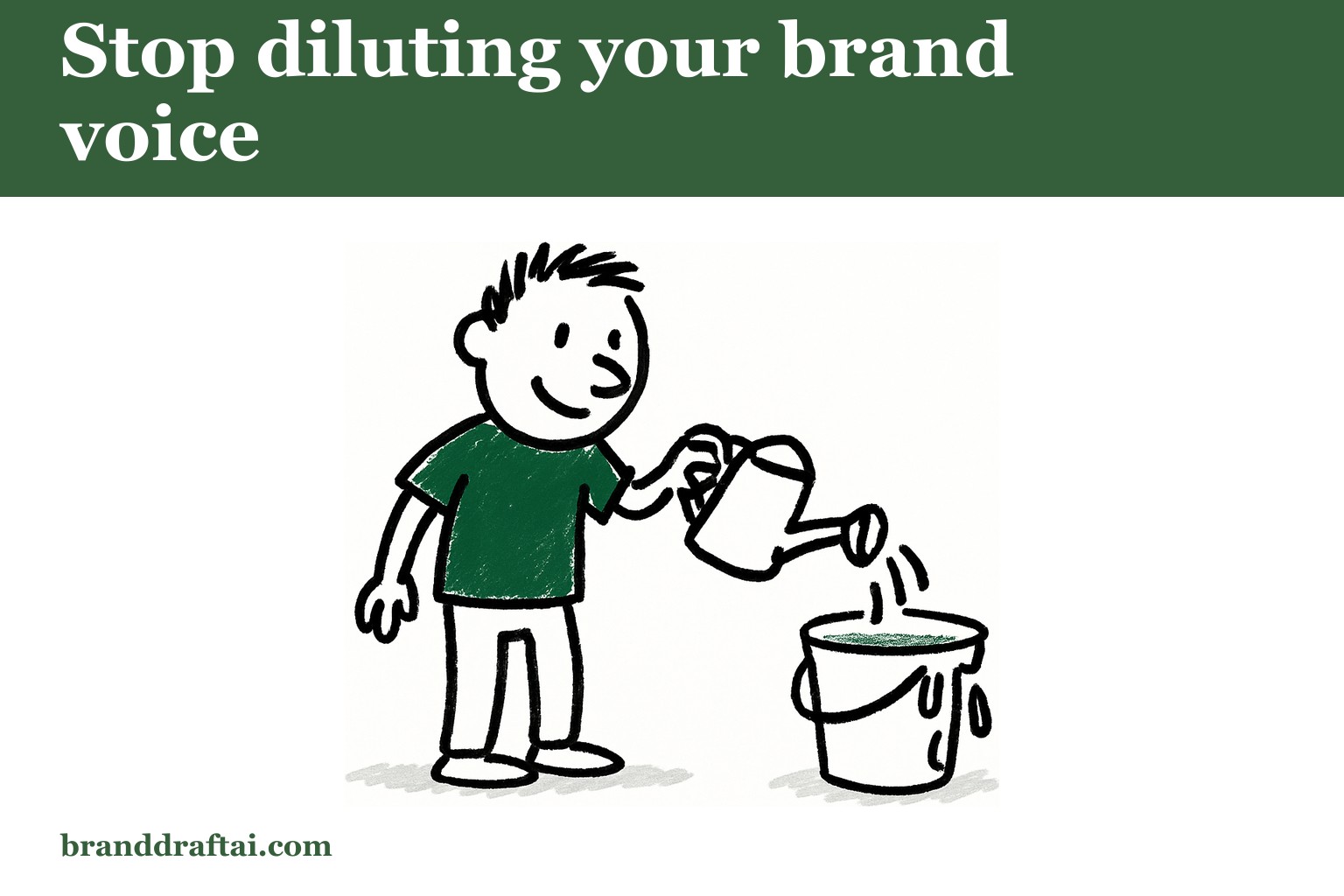

Why publishing more content is making your brand voice worse
The content calendar shows green checkmarks down the entire month. Three blog posts per week, two social media updates daily, weekly newsletters. The marketing team is hitting every deadline, the analytics dashboard shows consistent publishing volume, and the brand voice is quietly dissolving.
It happens gradually, then all at once. Week one, the articles sound like your company. Week twelve, they sound like every other company in your industry talking about "innovative solutions" and "seamless experiences."
The math seems obvious: more content equals more brand exposure equals stronger brand recognition. But volume and consistency are not the same thing. Publishing more content is making your brand voice worse because the production schedule has overtaken the editorial process.
The content mill changes how people write
When the deadline is tomorrow and the topic is "5 Ways Our Product Improves Workflow Efficiency," writers reach for the safest language available. Generic industry terminology that can't possibly offend anyone or say anything wrong. The language that sounds professional because it sounds like everyone else.
This isn't a creativity problem or a talent problem. It's a structural problem. The content production system rewards speed and safety over distinctiveness. Writers learn quickly that "streamlined solutions" gets approved faster than "the tool that stops you from checking five different dashboards every morning."
The brand style guide exists, but it's not designed for industrial-scale content production. It has personality guidelines and tone descriptions, but no guidance for maintaining voice when you're writing about enterprise software integration for the fifteenth time this quarter.
Generic language spreads through content teams
One writer uses "best practices" in a headline. The editor approves it because it's not wrong. The next writer sees it in the published piece and figures that's the approved language now. Within a month, every article includes at least one reference to best practices, whether it fits or not.
The same pattern repeats with "leverage," "robust," "comprehensive," and dozens of other corporate non-words that mean everything and nothing. The vocabulary becomes self-reinforcing because each piece of content becomes reference material for the next piece.
And here's what nobody mentions in the content strategy meetings: generic language is easier to produce at volume because it requires no specific knowledge about what the company actually does. You can write about "improving operational efficiency" without understanding the product. You cannot write about "the integration that lets shipping managers see inventory changes in real-time" without knowing how the software works.
The approval process smooths out personality
The article starts with a specific example: "When Denver-based logistics company Freight Solutions needed to track 40,000 packages during peak season, their old system couldn't handle the volume." It comes back from legal review as: "When companies need to track high volumes of packages during peak periods, scalable solutions become critical."
Every round of feedback removes something specific and replaces it with something safe. The product name becomes "the platform." The customer's exact problem becomes "common challenges." The measurable result becomes "improved outcomes."
This isn't malicious. It's institutional self-preservation. Specific claims can be wrong. Generic statements can't be challenged. But generic statements also can't be remembered, shared, or connected to actual business results.
Publishing more content creates artificial deadline pressure
The editorial calendar shows twelve pieces of content due this month. The marketing team has capacity for twelve pieces of content. What the calendar doesn't show is time for research, interviews with product teams, or reviewing customer language. Mailchimp's editorial philosophy explicitly addresses this tension: their team publishes less content than most companies their size specifically because they've measured what happens to quality when production speed increases.
The deadline pressure creates a dependency on existing content for research. Writers start with what the company has already published, then add their own layer of interpretation. By the fourth generation of content, the connection to actual business operations has been completely severed.
BrandDraft AI reads your existing website content before generating new pieces, so the output references actual product names and terminology instead of generic industry language that could apply to any business in your space.
The volume commitment also creates topic fatigue. There are only so many angles on "Why Data Security Matters" before writers start reaching for increasingly abstract concepts that sound important but connect to nothing specific the company offers.
Volume metrics miss the real goal
The content report shows impressive numbers: 47 blog posts published, 156,000 words produced, 12% increase in organic traffic month over month. What it doesn't measure is whether anyone can tell this content came from your company specifically or whether it could have been written by any of your competitors.
Traffic metrics don't distinguish between people who found exactly what they were looking for and people who clicked through to realize this wasn't it. Time on page doesn't separate engaged reading from confused scanning. Bounce rate doesn't tell you whether visitors left because they got their answer or because the content was too generic to be useful.
The real measure is recognition. If someone reads your content without seeing the logo, do they know it's yours? If the answer requires checking the byline, the volume strategy is working against brand voice, not for it.
Quality control breaks down at scale
When you're publishing three times a week, the editorial process becomes triage. Check for obvious errors, make sure the keyword appears enough times, verify the links work. There's no time to ask whether this piece sounds like your company or whether it advances any specific business goal beyond "content marketing."
The brand voice review becomes a checklist item instead of a judgment call. Does it avoid offensive language? Does it match the basic tone guidelines? Does it include appropriate calls to action? Check, check, check. Published.
Meanwhile, the subtle elements that actually create distinctive voice , specific word choices, particular ways of explaining concepts, the problems the company talks about versus the ones it ignores , get smoothed out by deadline pressure and approval workflows that optimise for safety over specificity.
The compound effect accelerates
Month six of aggressive content production, the brand voice has shifted so gradually that nobody noticed the individual changes. But new employees joining the marketing team now use the current published content as reference material for what "sounds like the company." They're learning to write like the generic version, not the original brand voice.
Customer-facing teams start adopting the same language because it's what appears on the website. Sales presentations begin including phrases like "comprehensive solutions" because that's how marketing describes the products. The generic language spreads beyond content marketing into actual business communications.
This creates a feedback loop where the original brand voice gets further diluted with each new piece of content, each new employee, each new department that treats published content as the authoritative guide to how the company talks about itself.
The content calendar still shows green checkmarks. The publishing schedule remains intact. But somewhere between week one and week fifty-two, the brand voice got lost in the production process, and volume metrics can't measure what's missing.
Generate an article that actually sounds like your business. Paste your URL, pick a keyword, read the opening free.
Try BrandDraft AI — $9.99