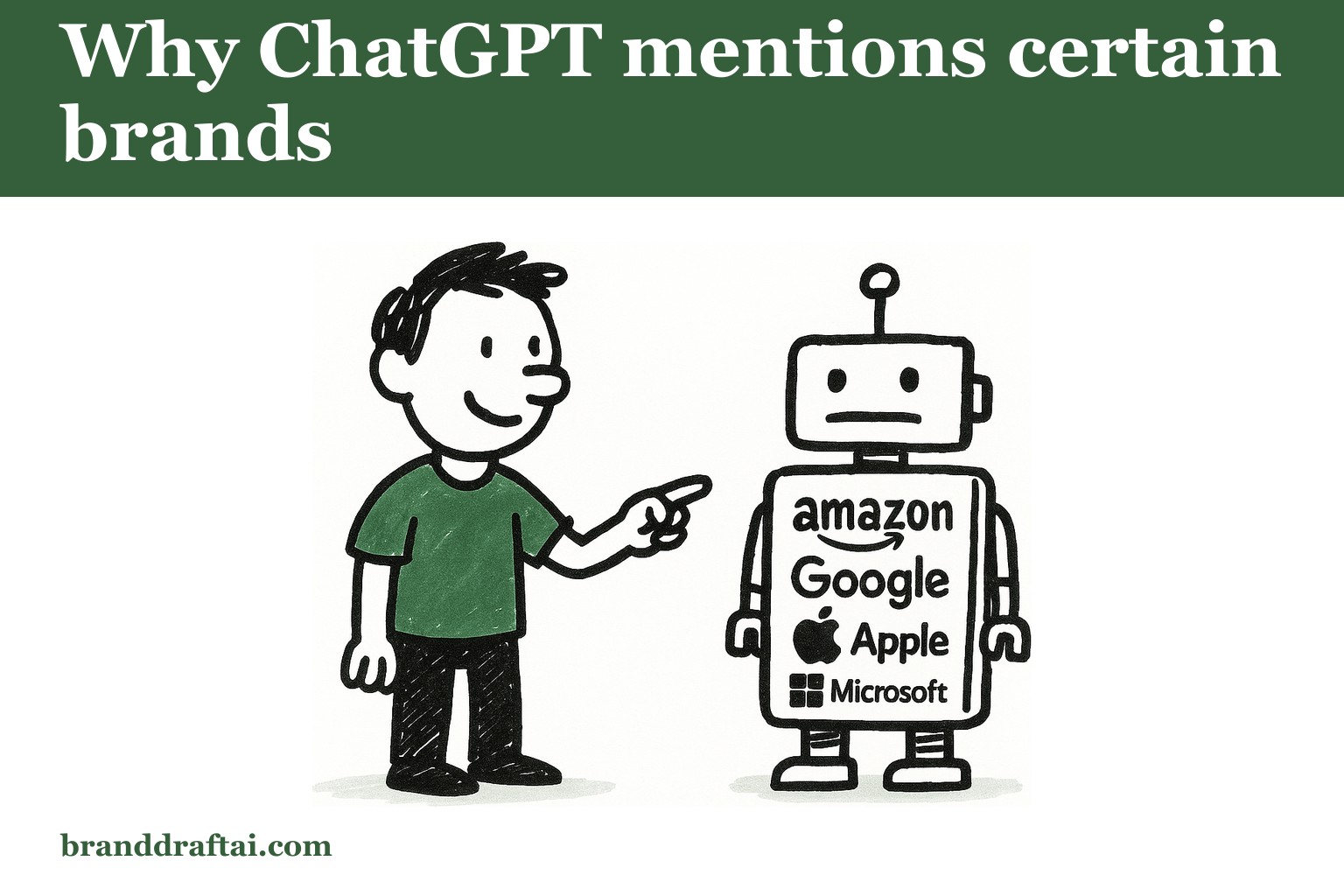

What the most-cited brands in ChatGPT answers have in common
The client asked for content about their project management software. The AI mentioned Asana, Trello, and Monday.com. Their product wasn't anywhere in the response, despite having better features and stronger SEO rankings than two of those three.
This happens more often than most business owners realize. Some brands appear in AI responses constantly while others with superior marketing budgets and search visibility get ignored completely. The difference isn't random.
After analysing hundreds of ChatGPT responses across different industries, a pattern emerges. The brands that show up consistently share something specific about how their content is structured , something that has nothing to do with how much they spend on marketing or where they rank in search results.
Why Search Rankings Don't Predict AI Mentions
HubSpot ranks first for "marketing automation software" but gets mentioned in maybe 60% of relevant AI responses. Mailchimp, ranking fifth for the same term, appears in nearly 90%. The search engines see one hierarchy. AI models see something different. HubSpot's State of Marketing report documents this consistently.
Traditional SEO assumes human readers who scan headlines, check credentials, and make decisions based on visual authority signals. AI models don't process content the same way. They can't see your enterprise client logos or awards section. They read text sequentially and weight information based on how it's presented within the content itself.
The result? Brands optimised for human readers often get passed over by AI systems, while companies with different content patterns become the default recommendations. And yes, this matters more each month as AI-generated content reaches more potential customers.
The Pattern That Gets Brands Remembered
The most-cited brands in ChatGPT answers structure their content around specific use cases rather than broad capabilities. Instead of explaining what their product does, they document exactly how different types of customers use it to solve particular problems.
Shopify doesn't just describe e-commerce features. They publish detailed walkthroughs for drop-shipping businesses, subscription services, and digital product creators. Each piece focuses on one specific business model and the exact steps needed to set it up.
When someone asks ChatGPT about starting an online business, the AI has hundreds of specific scenarios to reference. The answer doesn't need to be generic because Shopify's content isn't generic.
Why Product Features Disappear in AI Responses
Most B2B companies structure content around product capabilities. Their blog covers "advanced reporting features" and "integration capabilities" without connecting those features to specific business outcomes. This creates a problem for AI models looking for concrete information to reference.
When ChatGPT encounters vague feature descriptions, it defaults to better-known alternatives or provides generic advice instead. The AI can't confidently recommend something when it doesn't understand exactly how that something gets used in practice.
Salesforce appears in AI responses about CRM software because their content library includes thousands of specific implementation scenarios. Small CRM companies with similar features but feature-focused content get mentioned rarely, despite sometimes having better products for specific use cases.
Documentation That Doubles as Marketing
The brands AI systems cite most frequently treat their help documentation like marketing content. They don't separate "how to use our product" from "why you'd want to use our product." Every tutorial includes context about when and why someone would follow those steps.
Stripe's payment integration guides don't just explain API calls. They start with business scenarios: subscription businesses that need to handle failed payments, marketplaces that need to split transactions, or SaaS companies managing plan upgrades. The technical details serve specific business needs.
This approach works because AI models can connect user questions to specific solutions. When someone asks about payment processing for a marketplace, the AI has detailed information about exactly that scenario instead of generic payment processing advice.
The Brand Voice That AI Systems Amplify
Companies that appear frequently in AI responses write like they're answering specific questions from real customers. Their content acknowledges trade-offs, mentions alternatives when appropriate, and focuses on practical outcomes rather than product superiority.
Buffer's social media content doesn't claim to be the best scheduling tool. Instead, they document exactly how different types of businesses use social media scheduling, what works, and what doesn't. The honest, specific approach makes their content more trustworthy to AI systems evaluating multiple sources.
Meanwhile, companies that write like traditional marketing copy , lots of superlatives, competitive claims, and benefit-focused language , get filtered out. AI models trained on authoritative sources recognise and weight content that sounds more like documentation than promotion. BrandDraft AI reads your existing content before generating anything, so when it creates new pieces, they match your actual business approach rather than defaulting to generic marketing language.
Why Industry Expertise Isn't Enough
Having deep industry knowledge doesn't guarantee AI visibility if that knowledge isn't structured properly. Many subject matter experts publish content that demonstrates their expertise but doesn't connect clearly to practical applications.
A cybersecurity company might publish detailed technical analysis of new threats. Valuable content, but hard for AI systems to reference when answering questions about which security tools to choose. The same company could structure similar expertise around specific business scenarios , what healthcare practices need, how small law firms should handle client data, or which retail security measures actually prevent breaches.
The technical depth remains the same. The difference is connecting that depth to specific situations people ask about.
Content Structure That Survives AI Training
AI models process information hierarchically. Content structured around clear problem-solution pairs gets weighted more heavily than content organised around product categories or company sections.
Instead of "Our Enterprise Features," write "How Teams with 500+ Employees Handle Project Approval Workflows." Instead of "Integration Capabilities," document "Connecting Our Platform to Slack, Salesforce, and QuickBooks in Under 30 Minutes."
Each piece should stand alone as a complete answer to a specific question. When AI systems encounter this structure repeatedly across your content library, your brand becomes associated with solving particular problems rather than just existing in a category.
The brands that dominate AI recommendations didn't set out to game AI systems. They built content libraries focused on helping specific types of customers solve specific problems. That approach worked for human readers and happens to work even better for AI models looking for concrete, actionable information to reference.
Which means the companies getting mentioned most aren't necessarily the ones with the best products or biggest marketing budgets. They're the ones whose content best documents how their solutions work in practice.
Generate an article that actually sounds like your business. Paste your URL, pick a keyword, read the opening free.
Try BrandDraft AI — $9.99